How to Teach Italian to Siblings of Different Ages at the Same Time
When you have a two-year-old pulling at your leg, a five-year-old asking when it's their turn, and a seven-year-old announcing they're bored—all while you're trying to teach Italian—separate lesson plans for each child feel impossible. The good news: you don't need them. The most effective Italian learning happens when siblings learn together, each taking what they need from the same shared experience.
The secret is choosing activities flexible enough to meet children where they are developmentally, while keeping everyone engaged in the same moment. A well-chosen story, game, or routine naturally offers entry points for different ages—your toddler absorbs sounds and rhythms, your preschooler picks up vocabulary and phrases, your older child starts noticing patterns and constructing sentences. Same activity, different learning depths.
Why Multi-Level Learning Works for Language Acquisition
Children don't learn languages in tidy, age-segregated boxes. In bilingual families across Italy, children of all ages learn together at the dinner table, during passeggiata, through overheard conversations. The younger ones pick up intonation and context; the older ones model pronunciation and try out new structures. This natural immersion actually accelerates learning for everyone.
When siblings learn Italian together, the older child reinforces their own knowledge by demonstrating for younger siblings. The middle child benefits from both modeling the older sibling and simplifying for the younger. The toddler absorbs far more complex language than they could produce, building a foundation for later speech. Everyone stays motivated because learning feels like family time, not school.
Research on mixed-age language learning shows children regulate their own participation naturally—they're not frustrated by material slightly above or below their level when it's embedded in a meaningful shared context. Your job isn't to control who learns what, but to create rich language experiences everyone can access simultaneously.
Storytelling That Scales Across Age Groups
Stories are your most powerful tool for teaching Italian to siblings of different ages at the same time. A good story holds a toddler's attention with rhythm and pictures, gives a preschooler vocabulary and emotional context, and offers an early elementary child narrative structure and new grammatical patterns—all at once.
Choose stories with repetitive phrases and strong visual elements. When you read La piccola brucola molto affamata (The Very Hungry Caterpillar), your toddler learns brucola and affamata from context and repetition. Your five-year-old connects days of the week and counting. Your seven-year-old notices past tense verbs and starts predicting what happens next in Italian.
Read the same story multiple times across the week, but vary how you interact with it. Monday might be straight reading with voices and sound effects. Wednesday, pause for predictions: Cosa mangerà domani? Friday, let your oldest retell parts while younger siblings act it out. Same story, differentiated engagement, zero extra prep.
Personalized bilingual books work especially well here because every child sees themselves in the story. At Favola, you can create a personalized book where each of your children becomes a character in an Italian adventure—the story naturally addresses them by name and adapts to include siblings, making everyone feel the story is theirs while learning the same Italian vocabulary and phrases together.
Language Games Everyone Plays at Their Own Level
Games remove the pressure of "getting it right" and let each child participate according to their ability. The key is choosing games with simple mechanics but unlimited complexity—where a toddler can play by pointing and a seven-year-old can play by constructing full sentences.
Cerca e trova (Seek and Find): Hide objects around a room and give clues in Italian. For your toddler: Dov'è la palla rossa? For your preschooler: Cerca qualcosa che si mangia. For your older child: Trova un oggetto che inizia con la lettera S e descrivilo. Same game, complexity adjusted on the fly.
Simon dice (Simon Says): Give commands in Italian. Your toddler learns body parts and basic verbs (tocca il naso). Your five-year-old follows two-step commands (salta e poi siediti). Your seven-year-old becomes Simon and creates their own commands, producing language rather than just comprehending it.
Memory card games: Use picture cards with Italian labels. Younger children match by image while hearing the words. Older children must say the word before flipping or make a sentence using both cards they've matched. Everyone plays the same game at the table.
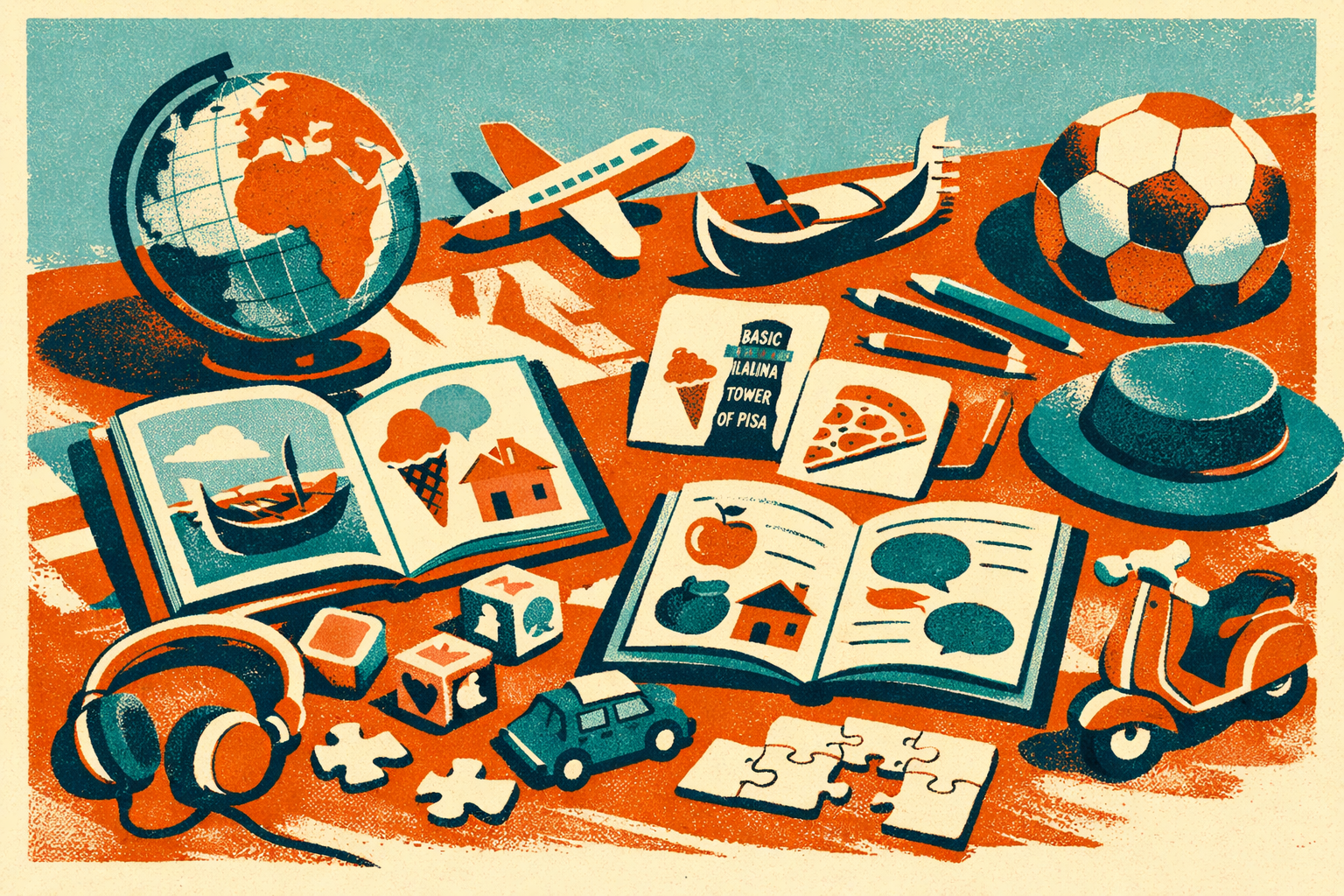
Charades con parole (Word Charades): Act out Italian words or phrases. Draw from a hat mixed with different difficulty levels—gatto, mangiare la pizza, andare in bicicletta, essere molto stanco. Children naturally choose cards they can handle, or team up across ages.
Daily Routines as Differentiated Language Anchors
Your most powerful teaching moments aren't planned lessons—they're the routines you repeat daily. Consistent Italian phrases during meals, bedtime, and transitions create language anchors that each child internalizes at their own pace.
During breakfast, narrate what's happening in simple Italian: Versiamo il latte. Il latte è freddo. Vuoi più pane? Your toddler learns food words through repetition. Your preschooler starts responding Sì, grazie or No, grazie. Your older child might offer, Posso aiutare? or Voglio i cereali, per favore. You're not teaching a lesson—you're living in Italian together.
Bedtime routines offer rich opportunities. Sing the same Italian lullaby every night—Stella stellina or Ninna nanna. Your youngest absorbs melody and comfort. Your middle child learns the words. Your oldest might sing along or ask what the words mean, leading to deeper vocabulary discussions.
Transition phrases work beautifully: Andiamo! (Let's go!), È ora di... (It's time to...), Aspetta un momento (Wait a moment). These high-frequency phrases get used dozens of times daily. Within weeks, all your children understand them. Within months, they're using them with each other.
Leveraging Sibling Dynamics to Reinforce Learning
Your children's relationships are a language-learning asset. Build activities that use what they already do—negotiate, cooperate, compete, teach each other—as Italian practice.
Assign the oldest child simple teaching responsibilities: Insegna a tuo fratello tre animali in italiano. This cements the older child's knowledge while modeling for younger siblings. The middle child can help the youngest with puzzle words or song lyrics. Teaching is one of the most effective ways to learn.
Cooperative challenges work well: Insieme, nominate dieci cose in questa stanza—in italiano. They have to pool their vocabularies, with older children helping younger ones contribute. Celebrate the collective achievement, not individual performance.
Use gentle competition for children who thrive on it: Chi può fare più rime con 'gatto'? or Vediamo chi trova più cose blu e le nomina in italiano. Set it up so everyone can win in their own category—youngest finds three, middle finds five, oldest finds seven and uses them in sentences.
Adapting Complexity Within Single Activities
The practical question parents ask most: How do I actually adjust difficulty in the moment without stopping the activity? Here are specific techniques that work seamlessly.
Layer your questions. When looking at a picture book, ask different children different questions about the same page: Cosa vedi? (What do you see?) for your youngest, Di che colore è il gatto? (What color is the cat?) for your middle, Cosa pensi che succederà dopo? (What do you think will happen next?) for your oldest.
Accept different response types. When you ask Cosa vuoi per merenda? (What do you want for snack?), let your toddler point or say one word (mela), your preschooler make a simple request (Voglio biscotti), and your older child construct a full sentence (Posso avere una mela e un po' d'acqua, per favore?). They're all practicing at their frontier.
Offer sentence starters. For open-ended activities, give your younger children stems to complete: Oggi vedo..., Mi piace..., Voglio... Your older child can start from scratch. Everyone participates successfully.
Vary task roles. During a cooking activity in Italian, your toddler can hand you ingredients you name, your five-year-old can stir while you describe what's happening, and your seven-year-old can read the simple recipe steps aloud. Different roles, same experience, everyone learning.
Using Visual Supports for Multi-Level Comprehension
Pictures, props, and gestures are equalizers—they give your youngest children access to meaning while adding richness for older children who are building more abstract language skills.
Create an Italian word wall with pictures at your children's eye level. Your toddler learns by looking and listening when you point. Your preschooler practices recognition. Your older child uses it for spelling or to build sentences during playtime.
Use real objects whenever possible. When teaching kitchen vocabulary, hold up il cucchiaio, la forchetta, il coltello. Everyone sees the same object, but your youngest is learning the sound-to-object connection, your middle child is categorizing utensils, and your oldest might be ready to discuss which one we use for soup in Italian.
Gestures and total physical response (TPR) work across all ages. When you say saltiamo and everyone jumps, or sediamoci and everyone sits, comprehension is immediate regardless of language level. Your toddler is learning verbs kinesthetically. Your seven-year-old is cementing conjugation patterns through muscle memory.
Building Vocabulary Banks Everyone Contributes To
Instead of teaching vocabulary in isolation, build family Italian word collections around themes everyone experiences: la nostra casa, il parco, i nostri giocattoli, la famiglia.
Make it visual and collaborative. Hang a large paper in your kitchen labeled Il cibo che amiamo. Over the week, everyone adds drawings or cut-out pictures with Italian labels. Your toddler draws scarabocchi (scribbles) of banana. Your five-year-old cuts out pizza. Your seven-year-old writes gli spaghetti in their own handwriting. The poster becomes a reference point and a source of pride.