How to Teach Spanish to Your Toddler When You Only Speak a Little
You want your toddler to speak Spanish. Maybe it's the language of your grandparents, or perhaps you're drawn to the cultural richness it represents. But there's a problem: your own Spanish is shaky at best. You know colors and numbers, maybe a handful of phrases, but carrying a conversation? That's another story entirely.
Here's the truth that language experts wish every parent knew: your imperfect Spanish is not just good enough—it's actually valuable. Your toddler doesn't need a university professor. They need consistent exposure, emotional connection, and a parent who shows them that learning is joyful, not perfect. Let's explore exactly how to teach Spanish to your toddler when you only speak a little, with strategies that work in real life, not just in theory.
Why Your Limited Spanish Is More Powerful Than You Think
Before diving into methods, let's address the fear that keeps many parents silent: "What if I teach them wrong?"
Research on early childhood language acquisition reveals something fascinating. Toddlers between 18 months and 3 years are in the optimal window for phonetic learning. They're absorbing sounds, patterns, and vocabulary at a neurological level that we adults can barely comprehend. When you speak Spanish to them—even haltingly—you're creating neural pathways for that language.
Your accent? It won't "damage" their Spanish. Children naturally tune into the dominant accent they hear most frequently. If they hear native Spanish from books, songs, or media alongside your efforts, they'll calibrate toward those models while still benefiting from your emotional engagement.
More importantly, you're modeling something invaluable: language learning as a shared family journey rather than a performance. When your toddler sees you trying, stumbling, and persisting, they internalize that making mistakes is part of growth.
Start With What You Already Know: The Labeling Method
The most accessible entry point requires almost no fluency: labeling your physical environment. This strategy works because it's concrete, repetitive, and fits naturally into your existing routines.
Begin with 5-10 household items your toddler interacts with daily:
- La puerta (the door) - say it every time you open or close one
- La ventana (the window) - point and name it during daytime routines
- La cuchara (the spoon) - use during meals
- El agua (the water) - essential for bath time and drinking
- Los zapatos (the shoes) - perfect for getting dressed
Don't worry about teaching them to say these words back immediately. At this age, receptive vocabulary (what they understand) develops months before expressive vocabulary (what they say). Your job is simply consistent input.
Here's the key: don't translate back to English immediately afterward. Say "la puerta" while touching the door, then move on with your day. Let the meaning come through context and repetition, just as it would if you were living in a Spanish-speaking country.
Narrate Daily Routines in Simple Spanish Phrases
Once you're comfortable with nouns, add verbs through routine narration. You don't need complex grammar—toddler-directed speech is naturally simplified, and that's developmentally appropriate.
Pick one routine and commit to narrating it in Spanish for two weeks. Breakfast is ideal because it's consistent and involves clear, concrete actions:
- "Vamos a comer" (We're going to eat)
- "Siéntate, por favor" (Sit down, please)
- "Más leche?" (More milk?)
- "Está caliente" (It's hot)
- "Terminado" (All done)
These phrases don't require you to know much Spanish at all. Write them on a sticky note in your kitchen if needed. Use a translation app to check pronunciation—hearing it once or twice is enough to approximate it, and approximation is absolutely sufficient at this stage.
After breakfast feels natural, add another routine. Bath time offers wonderful language opportunities: "agua" (water), "jabón" (soap), "limpio" (clean), "mojado" (wet). Getting dressed provides clothing vocabulary. Bedtime offers "cansado" (tired), "pijama" (pajamas), "libro" (book).
Leverage Picture Books and Audio Resources as Your Teaching Partner
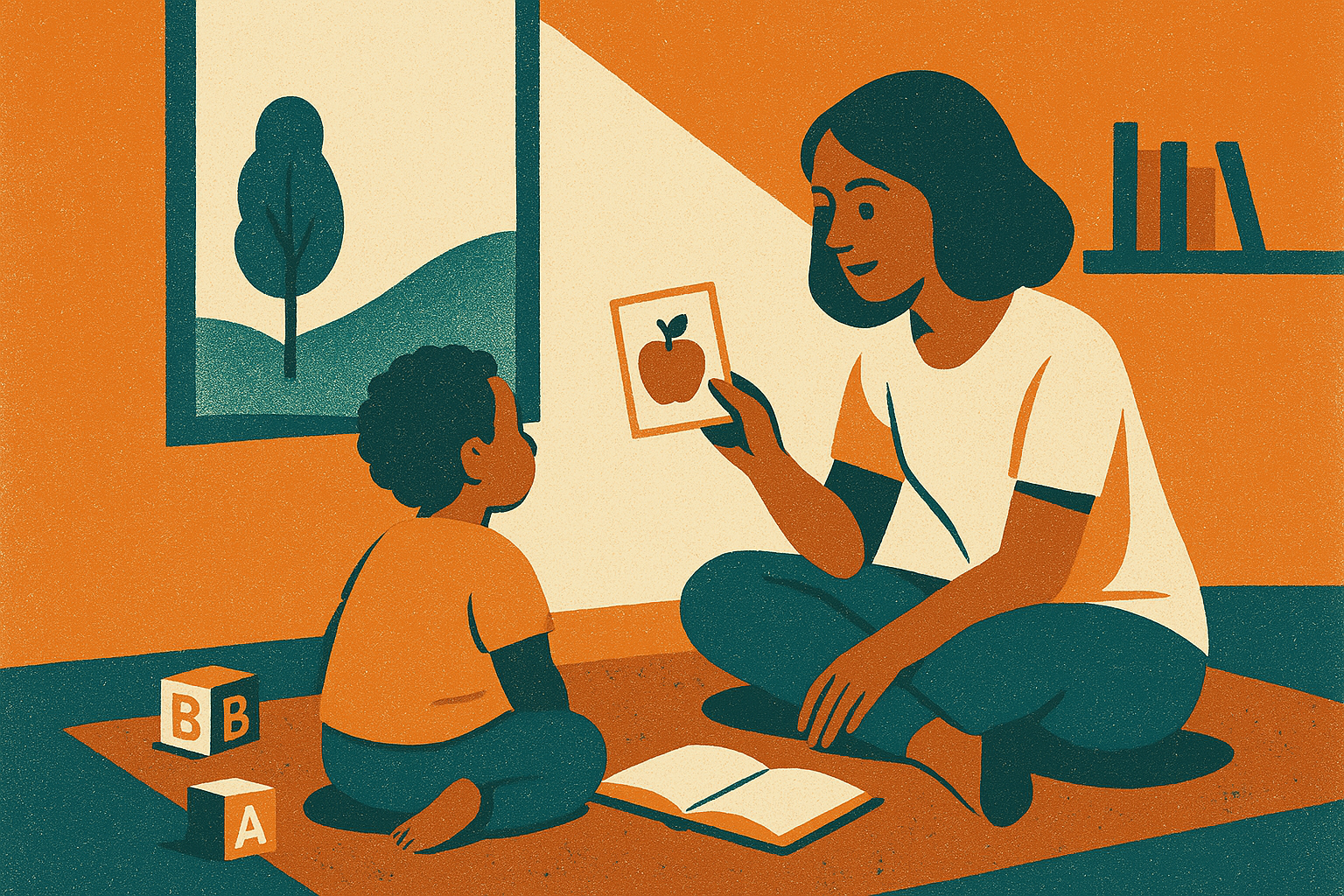
This is where you can effectively multiply your Spanish input without increasing your own language burden. Picture books with audio components let native speakers handle pronunciation while you handle the cuddles and page-turning.
Look for books with these characteristics:
- Simple, repetitive text ("Buenas noches, luna" patterns work beautifully)
- Clear, engaging illustrations that make meaning obvious
- Audio narration by native speakers (many apps and publishers offer this)
- Cultural authenticity rather than direct translations of English books
Your role during Spanish book time isn't to read aloud perfectly—it's to facilitate the experience. Play the audio, point to pictures, make sound effects, show enthusiasm. Your toddler associates Spanish with warmth and attention, which is far more important than your pronunciation accuracy.
Personalized books where your child becomes the story's hero offer a unique advantage here: toddlers engage more deeply with stories about themselves, increasing repetition requests and therefore total exposure hours. When the book includes audio from native speakers, you get pronunciation support without the pressure.
Use Music and Simple Songs (The Lower-Pressure Spanish Practice)
Singing is cognitively different from speaking. The melody carries you through pronunciation challenges, rhythm aids memory, and there's no conversational pressure. Even better, toddlers are naturally drawn to music and will request the same songs endlessly—exactly the kind of repetition that builds language skills.
Start with songs that have physical actions attached, as these create multi-sensory learning:
- "Cabeza, Hombros, Rodillas, Pies" (Head, Shoulders, Knees and Toes) - teaches body parts with movement
- "Los Pollitos Dicen" (The Little Chicks Say) - animal sounds plus family vocabulary
- "Estrellita, ¿Dónde Estás?" (Twinkle Twinkle) - familiar melody, simple Spanish words
Find YouTube videos or Spotify playlists with these songs. Listen during car rides, play them during toy time, dance to them in the living room. You don't need to memorize all the words immediately—learn one verse, sing that on repeat, add more as you become comfortable.
The beauty of music is that your toddler won't critique your accent. They'll simply absorb the sounds and associate Spanish with joy, movement, and your attention.
Managing Your Worries: Common Fears and Reality Checks
"Won't my accent confuse them or limit their Spanish?"
Your accent provides one data point among many. If your child also hears Spanish through books, songs, videos, or occasional native speakers, they'll naturally converge toward those models for pronunciation while still benefiting from your vocabulary input. Think of it this way: children raised in non-English-speaking households who attend English schools don't end up speaking like their parents—they integrate multiple inputs. The same principle applies here.
"What if I teach them the wrong word or use incorrect grammar?"
At the toddler stage, communication matters more than grammatical perfection. If you accidentally use the wrong gender article or conjugate a verb incorrectly, you're still providing Spanish exposure. As they grow and encounter correct usage through media and books, they'll self-correct naturally. That said, using a bilingual book where professional translators ensure accuracy alongside your efforts gives you a reliable reference point.
"I freeze up when trying to speak Spanish to my child. It feels unnatural."
Start smaller. You don't need to switch your entire interaction style to Spanish immediately. Commit to just one category: maybe all color words you use will be in Spanish this month. Or all food-related vocabulary. This compartmentalized approach feels less overwhelming and still provides meaningful exposure. As one category becomes comfortable, you naturally expand to others.
"Is it worth it if I'm not fluent? Will they really learn?"
Research consistently shows that any additional language exposure during the critical period (birth to age 5) creates lasting cognitive and linguistic benefits. Even children who become "dormant bilinguals"—those who stop actively using a language but were exposed early—retain passive understanding and relearn the language much faster later in life. Your imperfect efforts today create scaffolding for future language learning, even if your toddler doesn't become fluent right away.
Creating a Sustainable Spanish Routine That Fits Your Life
The strategies above only work if they're maintainable. Here's a realistic weekly framework for parents with limited Spanish:
Daily non-negotiables (5-10 minutes total):
- Label 3-5 objects during one routine (breakfast, bedtime, bath)
- Play one Spanish song during transition time
3-4 times per week (10-15 minutes each):
- Read or play audio of one Spanish picture book
- Narrate an activity in simple Spanish phrases (building blocks, coloring, playing with toys)
Weekly bonus (if energy permits):
- Watch a short Spanish-language cartoon together
- Video call with a Spanish-speaking relative or friend who can chat with your toddler
This amounts to roughly 15-20 minutes of Spanish exposure on busy days, 30-45 minutes on better days. That's enough to build familiarity, vocabulary foundations, and positive associations with the language. It's not immersion, but it's exponentially more than zero—and zero is the alternative if perfectionism keeps you silent.
How Bilingual Books Support Parents Learning Alongside Their Children
One of the most practical tools for parents with limited Spanish is the bilingual picture book—not the kind with dense text blocks in two languages, but books thoughtfully designed with simple, clear translations that you can actually learn from.
When you read these books repeatedly (and toddlers will demand repetition), you're not just teaching your child—you're teaching yourself. You begin to internalize the Spanish words for common objects and actions. The side-by-side format lets you check your understanding without breaking the reading flow.
Investing in books that feature your specific child as the main character increases the likelihood they'll request these books daily, which means you're both getting consistent Spanish practice embedded in your existing bedtime or reading routine. The personalization factor turns language learning into quality bonding time rather than an educational task.