Montessori Language Learning at Home: A Parent's Guide
When my daughter was three, I watched her spend twenty minutes arranging wooden fruit in her play kitchen, narrating everything in a mix of English and Italian. She wasn't following a curriculum or completing a worksheet. She was doing exactly what Maria Montessori understood a century ago: children learn language through purposeful interaction with their environment, not through drilling or abstraction.
If you're raising a bilingual child or introducing a second language at home, Montessori principles offer a remarkably practical framework. These aren't theoretical ideals—they're concrete strategies that align with how young children's brains actually acquire language.
The Montessori Foundation for Language Acquisition
Maria Montessori observed that children pass through sensitive periods when they absorb language effortlessly, roughly from birth to age six. During this window, they don't learn language the way adults do—through conscious study. They absorb it from their environment like a sponge absorbs water.
This has profound implications for Montessori language learning at home. Instead of sitting your child down for "Spanish lessons," you create an environment where the second language is a natural, functional part of daily life. The language isn't the subject—it's the medium through which your child explores their world.
Three Montessori principles guide everything:
- Concrete before abstract: Children need to touch, manipulate, and experience before they can understand symbols or concepts
- Follow the child: Language activities should match your child's interests and developmental readiness
- Purposeful activity: Language serves real communication needs, not arbitrary exercises
Creating a Language-Rich Prepared Environment
The Montessori "prepared environment" isn't about buying expensive materials. It's about organizing your home so language learning happens organically as your child moves through their day.
Start with labeling. In a Montessori classroom, materials have their place, and that place is labeled. Do the same at home in your target language. Create simple labels for everyday objects—la porta, la fenêtre, la ventana. Use lowercase letters on neutral card stock. Place them at your child's eye level.
This isn't decoration. Your child will touch these labels, trace them with their fingers, and begin to connect the written word with the object. You're building print awareness in two languages simultaneously.
Next, curate a small bilingual library. Choose books with realistic illustrations over cartoon characters. Montessori favors reality-based content, especially for children under six. Look for simple vocabulary books about animals, plants, geography, and daily routines. Personalized books where your child appears as the character are particularly powerful—they make the language personally relevant and concrete.
Practical Life Activities in Your Target Language
Montessori's "practical life" exercises—pouring, spooning, buttoning, food preparation—are language goldmines. These activities require you to demonstrate, name materials, describe actions, and give simple instructions. All in your target language.
Set up a low shelf with real materials: a small pitcher, child-sized tongs, a whisk, measuring spoons. Invite your child to help with real tasks: washing vegetables, setting the table, arranging flowers. Narrate everything in the target language using simple, precise vocabulary.
"First, we fill the pitcher with water. Now we pour slowly—watch the water flow. Can you dry the table with this cloth?"
This is comprehensive input: your child hears vocabulary in context, sees the action it describes, and participates in purposeful work. They're not learning the word for "pour" abstractly—they're pouring.
Sensorial Language Development
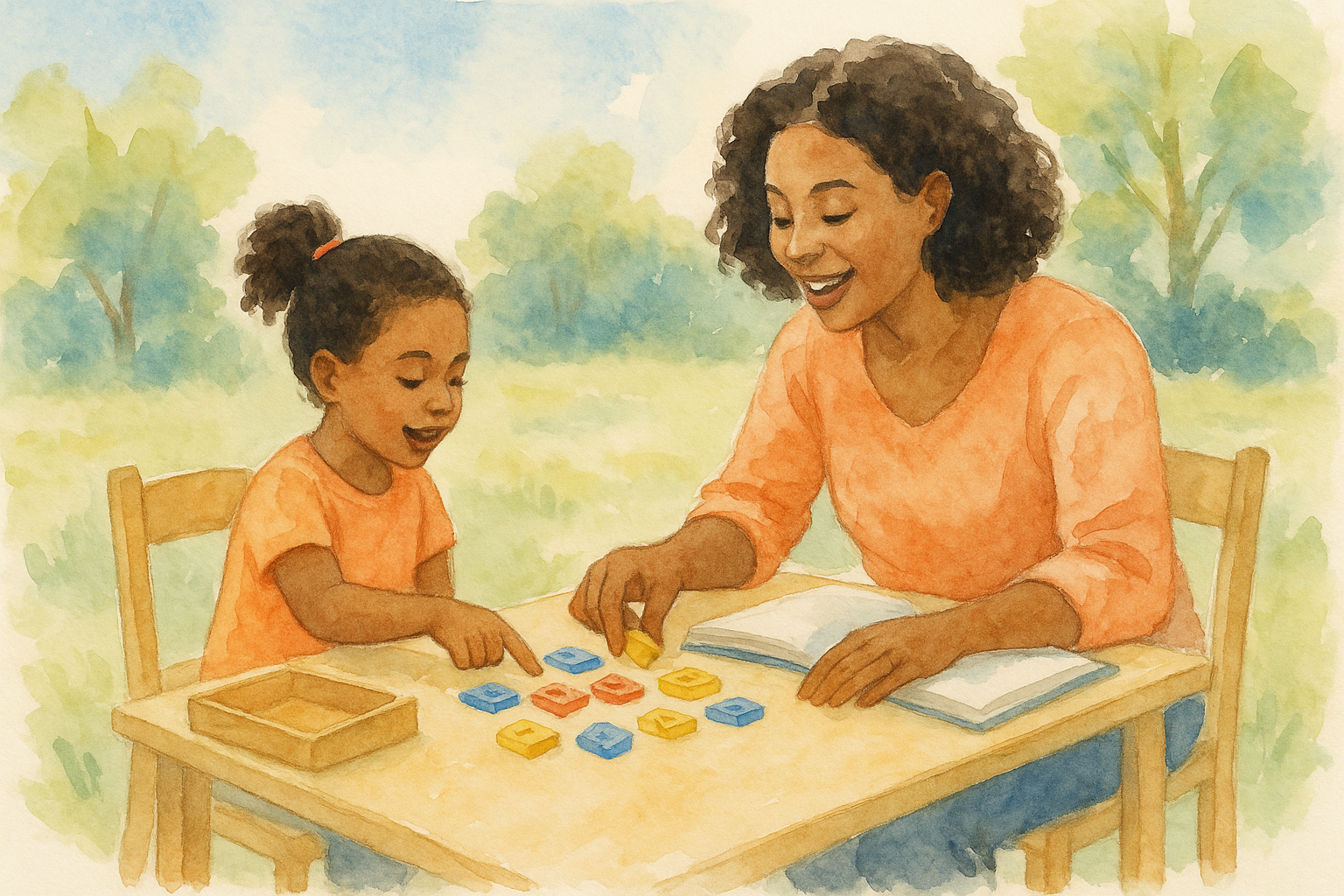
Montessori sensorial materials—color tablets, sound cylinders, fabric swatches—build precise vocabulary for descriptive language. You don't need official Montessori materials. Gather items from around your home.
Create texture cards by gluing different materials (sandpaper, velvet, bubble wrap) to cardboard squares. Build a color-matching game with paint chips. Fill small containers with rice, beans, and pasta for sound comparisons.
As your child explores these materials, introduce rich descriptive vocabulary in your target language: rough, smooth, loud, soft, dark blue, light blue. The sensory experience cements the word in a way flashcards never could.
The Three-Period Lesson for Vocabulary Building
Montessori's three-period lesson is elegantly simple and backed by cognitive science. It's how you introduce new vocabulary without pressure or testing.
Period One (Naming): Show three objects or pictures. Name each clearly: "This is a lemon. This is an orange. This is a lime." Use the target language exclusively. Repeat 2-3 times.
Period Two (Recognition): Ask your child to identify items: "Can you show me the lemon? Where is the orange?" Let them point or hand you items. This period can last days or weeks. Don't rush.
Period Three (Recall): Only when your child is confident, ask them to name items: "What is this?" If they're not ready, return to period two. No pressure, no correction that feels like failure.
This method respects your child's absorption timeline. Some words stick immediately; others need weeks of exposure. That's not a problem to fix—it's how language acquisition works.
Integrating Language Into Movement and Music
Montessori recognized that young children learn through movement. They cannot sit still to learn—they must move to learn. Use this.
Teach action songs, fingerplays, and movement games in your target language. Frère Jacques, Head, Shoulders, Knees and Toes, and simple circle games exist in nearly every language. The physical movement connects to the vocabulary kinesthetically.
Create a "walking the line" activity—a Montessori classic. Place a line of tape on your floor. As your child walks it, they can carry objects, balance a beanbag, or follow instructions in the target language: "Walk forward. Now walk backward. Stop. Turn around."
This isn't just gross motor development. It's impulse control, listening comprehension, and vocabulary building wrapped in purposeful movement.
Grace and Courtesy in Multiple Languages
Montessori places enormous emphasis on "grace and courtesy" lessons—teaching children the social scripts of their culture. This is language learning in its most authentic form.
Model and practice greetings, polite requests, and social niceties in your target language. Role-play scenarios: how to offer something to a friend, how to ask to join a game, how to excuse yourself.
These aren't abstractions. You're giving your child the actual phrases they need to navigate social situations. When they use these phrases successfully—when they ask for help in Italian and receive it—they experience language as powerful and useful.
At Favola, we build this concept into our personalized stories, where children see themselves navigating real situations in two languages, modeling exactly the kind of practical, social language use Montessori advocated.
Respecting the Silent Period
Here's where Montessori wisdom saves parents enormous anxiety: children often go through a silent period when learning a second language. They understand far more than they speak. They're absorbing, processing, building internal structures.
Don't pressure output. Don't quiz. Don't make speaking the target language a test they can fail. Continue providing rich input through all the activities above. Trust the process.
Your child will speak when they're ready, when they have something they want to say, when the internal structure is solid enough. Forced production before readiness can create anxiety around the language—the opposite of what you want.
Maintaining Consistency Without Rigidity
Montessori environments thrive on consistency, but this doesn't mean rigidity. You don't need to speak only the target language 24/7 unless that's your natural family pattern. What matters is creating predictable language contexts.
Perhaps mealtimes are always in French. Or bedtime stories are always in Spanish. Or Tuesday afternoons are Italian time. Your child learns to code-switch naturally, understanding that different contexts call for different languages.
This mirrors the natural bilingualism of communities where languages serve different functions—home language, school language, market language. It's authentic and sustainable.
FAQ
What age should I start Montessori language learning at home?
Montessori language activities can begin from birth, though they look different at each stage. Infants benefit from hearing songs and simple narration in the target language. Toddlers engage with practical life activities and concrete objects. By age three, children can participate in three-period lessons and more complex practical life work. The sensitive period for language extends to about age six, but it's never too late to begin—just adjust your approach to your child's developmental stage.
Do I need to be fluent in the second language to use Montessori methods?
Native fluency isn't required, but you do need enough proficiency to narrate daily activities, read simple books, and model correct pronunciation. If you're learning alongside your child, embrace that openly—it models lifelong learning. Focus on high-frequency, practical vocabulary first. Consider enriching your input with audiobooks, native speaker videos, and language exchange partners. The Montessori principle of "follow the child" applies to you too: work within your comfort zone and expand gradually.
How is Montessori language learning different from other bilingual methods?
Traditional language teaching often relies on abstraction, memorization, and decontextualized drills. Montessori language learning at home centers on concrete experiences, purposeful communication, and self-directed exploration. Children aren't completing worksheets about colors—they're sorting colored objects for a real reason. They're not drilling verb conjugations—they're using verbs to accomplish tasks they care about. The language emerges from genuine interaction with the environment and meaningful relationships, not from artificial exercises.
Can Montessori language methods work alongside formal language classes?
Absolutely. Montessori home practices provide the concrete foundation and real-world application that complement formal instruction beautifully. If your child attends a language class, reinforce concepts at home through practical life activities and hands-on materials. The Montessori approach fills the gap most classes can't address: using the language for authentic daily communication and purposeful activity.